
Take a paragraph of ChatGPT text and delete every word people call an AI tell. Cut "delve." Cut "tapestry," "underscore," "moreover." Swap in plain synonyms. Read it back. It still sounds like AI.
That is the part most takes get wrong. Everyone goes hunting for the guilty vocabulary, like the machine is hiding behind a dozen fancy words. It is not. I edit copy for a living. The thing that makes me sigh and grab the red pen is never one word. It is the rhythm. The shape of the sentences. The way the whole thing marches in step.
AI writing sounds the same because it moves the same. Here is what that actually means, tell by tell, from the ear of someone who reads for pattern instead of scanning for buzzwords.
The real signature is rhythm, not vocabulary
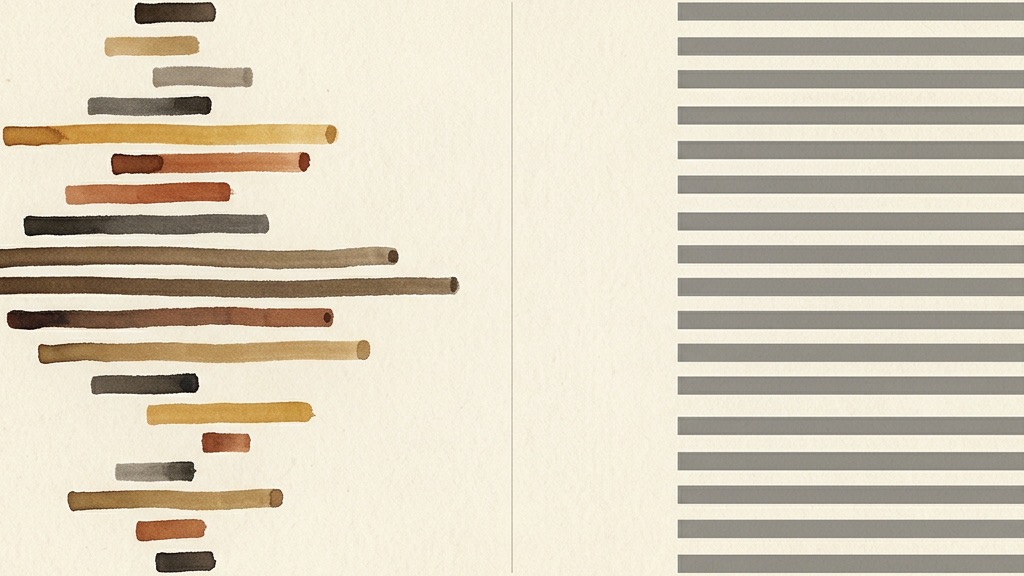
Human writing lurches. A long, winding sentence that piles clause on clause and takes its time getting where it is going, then stops. Hard. Two words. That swing between long and short is so reliable that AI detectors measure it directly and gave it a name: burstiness.
Burstiness is just the variation in your sentence lengths, calculated as the standard deviation across a passage. People write in bursts. We slam a twelve-word thought against a three-word one, then run thirty words downhill. According to GPTZero's own explanation of the metric, machine text lands in a narrow band of medium, evenly paced sentences and mostly stays there. Low burstiness. That flatness is the sound you are hearing.
Once you have caught it, good luck unhearing it. In an AI paragraph, one sentence runs about as long as the last, then the next matches both. Nothing lunges. Nothing trails off mid-thought and circles back. You get a smooth, level hum, line after line, a highway with no potholes and nothing worth looking at out the window.
Every claim comes wrapped in its own counterweight
Watch what a model does the second it makes a point. It walks it back. "While X matters, it is also worth weighing Y." "AI is powerful, but it has limits." Every claim shows up pre-balanced, the point and its counterpoint holding hands so nobody gets upset.
People do this too, sometimes. The difference is that AI does it every single time, at the level of reflex. It cannot let a sentence stand there being one-sided and alive. The result reads as scrupulously fair and completely bloodless. Nobody home. A real writer picks a side, or at least leans, and the lean is where the voice lives.
The rule of three, on a loop
Three is a genuinely lovely number in prose, and I will defend it. Some of the most quoted lines in English ride a triple beat. The catch is the word once. Used a single time, at the right moment, three lands like a drum hit you feel in your chest.
AI uses it constantly. Clear, concise, and compelling. Fast, reliable, and secure. Engaging, informative, and valuable. Three adjectives where one would do, three examples where two would land harder, the same little triple rhythm swinging around every corner. Once, it is rhetoric. On every third line, it is a tic. Start counting the threes in AI text and you will not be able to stop.
The same shape at every zoom level
Here is the structural tell, and it runs deepest. AI writing is fractally tidy. Zoom out to the whole piece and you get intro, body, neat wrap-up. Zoom into one section: topic sentence, a couple of supports, a little concluding button. Zoom into a single paragraph and there it is again, the same move.
Every unit is a miniature five-paragraph essay. It opens by telling you what it will say, says it, then tells you it said it, at every scale. That relentless self-similarity is comforting and dead. Human writing has lumps. A paragraph that is one furious sentence. A section that forgets to conclude because the writer got interested in something else and chased it.
Which brings up the last tell, the one under all the others.
It never leaves a loose end
AI resolves everything. Every tension introduced gets released, every question raised gets answered in the same breath, every plane it puts in the air lands gently on the runway before the section ends. Nothing is left hanging. Nothing trails off.
Real writing leaves threads loose on purpose. It drops a thought and trusts you to carry it. It ends a paragraph on a hard, unresolved beat and lets the silence do work. That willingness to not tidy up is deeply human, and it is exactly the instinct a model trained to be maximally helpful has had scrubbed out of it.
Why it defaults to this hum
The mechanics are simpler than they look. A model keeps picking the most probable next word, then does it again, and again, and all that probability-chasing drags it toward the average continuation. The average sentence runs medium length. Balanced is the average stance. And the structure? Tidy, every time. Nobody actually speaks in the average, but a model is built to.
Then a second training stage sands it further. Human raters reward answers that feel safe, even, and inoffensive, so the model learns that a press-release cadence never gets marked down and aims straight at it. The buzzwords are real, and knowing the specific phrases that give AI away helps at the surface. But the vocabulary is the paint. The rhythm is the frame, and swapping paint on the same frame leaves the same building.
Watch it happen on one paragraph
Here is a stretch of writing with every tell in it. Nothing wrong with a single word:
AI writing tools are powerful, but they have clear limitations. They can produce text quickly, accurately, and consistently. However, they often lack the personal voice that makes writing memorable. Understanding both the strengths and the weaknesses is important for any writer today.
Four sentences, all between eleven and fourteen words. A hedge in the first line, a tricolon in the second, a tidy summary to close. Flat hum, start to finish. Now the same idea, roughed up:
AI tools are fast. Genuinely, absurdly fast, faster than you can think up the second sentence. What they cannot do is sound like a person. The voice is missing, and no thesaurus buys it back.
Not a single new fact. I changed the beat. A four-word sentence, then a long one, then a claim with a lean in it, then a stop. Same content, and it no longer marches.
How to break the pattern
So if you want AI-assisted text to quit sounding like every other scrap of AI-assisted text, go after the structure. Not the word list. And read the thing out loud before you touch anything else. Your ear will catch that flat hum long before your eye does.
Then rough it up on purpose. Take a medium sentence and cut it in half so one part lands short. Take two others and fuse them into one long, breathless run. Delete a leg off every tricolon you find. Kill one hedge per paragraph and let the claim stand there exposed. End a section before it resolves, and leave the thread hanging.
This is why swapping synonyms never works, and why the better rewriting tools rework the sentence structure rather than the words. A good AI humanizer changes the rhythm itself, breaking the uniform sentence lengths and the tidy symmetry that detectors clock, instead of trading one adjective for another and leaving the beat untouched.
The uncomfortable bit, if you are trying to sound less like a machine: no thesaurus is going to save you. What saves you is nerve. Nerve to be uneven, to be a touch unfair, to wander off and leave a thought dangling. A model will not do that for you. You have to. And that, more than any word swap, is the whole game.