
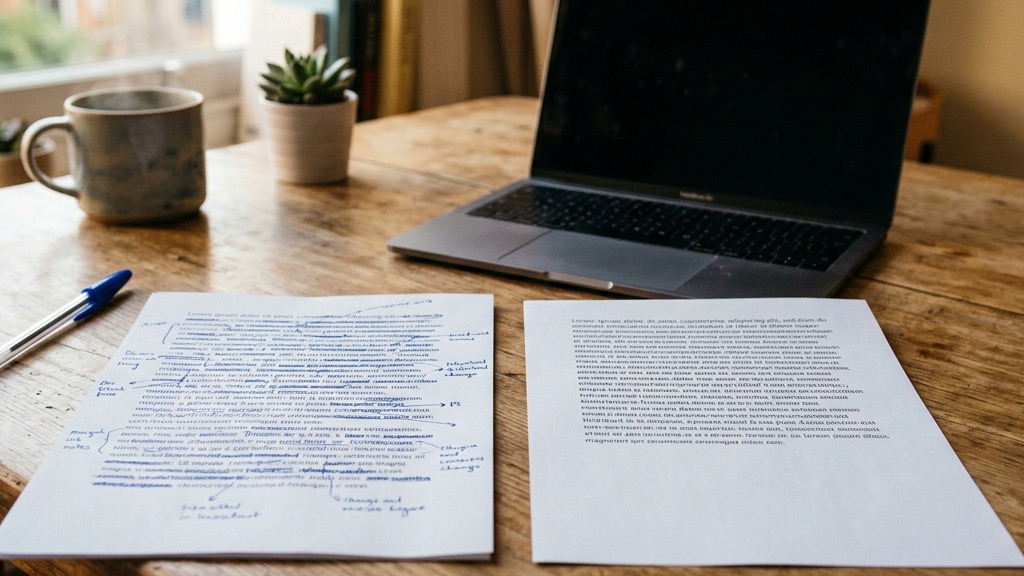
How to Humanize AI Text Without Losing Your Meaning
I took a 96-word ChatGPT paragraph about student time management and ran it through ZeroGPT. It scored 100% AI. One editing pass got it to 60.5%. A second pass got it to 0%. Total time: about fifteen minutes, and the paragraph came out saying more than it did when it started, not less.
That last part matters. Most advice about humanizing AI text is really advice about disguising it, and disguise is exactly where meaning gets mangled. What works is the opposite move. Make the text more specific. More committed. More yours. Here's the process I used, with the real before and after.
The before: what 100% AI looks like
Time management is a crucial skill for students in today's fast-paced academic environment. By implementing effective strategies, students can unlock their full potential and achieve their academic goals. First and foremost, it is important to create a structured schedule that allocates dedicated time for studying, rest, and extracurricular activities. Additionally, breaking large tasks into smaller, manageable chunks can significantly reduce feelings of overwhelm. Moreover, utilizing digital tools such as calendar apps and task managers can streamline the planning process.
Read it again and notice something: it contains no information. No numbers, no tools by name, no tradeoffs, nothing a reader could disagree with. It's generically true, which is exactly why a detector clocks it instantly and why a human skims past it. That diagnosis drives the whole fix.
Step 1: add information before you touch the style
This is the step every synonym-swapping guide skips, and it's the one that does most of the work. AI drafts hedge toward statements that are true for everyone, so the repair is to make them true for you specifically. Which schedule? How long? Which apps did you actually try, and which one lost?
In my rewrite, "create a structured schedule" became "Sunday night, twenty minutes." "Breaking large tasks into smaller chunks" became a 3,000-word paper split into an outline due Tuesday, sources by Thursday, 500 words a day after. Same claims, now carrying detail only a person who did the thing would know. You can't lose your meaning at this step. You're adding it.
Step 2: cut the scaffolding
AI drafts are wrapped in packaging: an opening sentence that restates the topic, transitions bolted to every seam, a closing sentence that summarizes what you just read. Delete all three layers. My before-paragraph loses its entire first two sentences ("crucial skill," "full potential") with zero loss of content, because they had none.
A quick test for any sentence: if the reader could have predicted it from the sentence before, it's scaffolding.
Step 3: break the rhythm
After the first pass, my paragraph still scored 60.5%. The words were mine but the shape was still ChatGPT's: every sentence roughly the same length, every clause resolving neatly. The second pass attacked structure only:
Sunday night, twenty minutes, that's my whole system. Classes and shifts go in first. Can't move those. Study time gets blocked in two-hour slots and never longer, because my focus is done around minute 90 whether I like it or not. Big assignments get chopped up the day they're assigned. That 3,000-word paper? Outline Tuesday. Sources Thursday. Then 500 words a day until it's done.
Fragments. A question answered immediately. One long sentence carrying a complaint, followed by three short ones. That irregularity is what dropped the score from 60.5% to 0%, and it's also just how people talk. Detectors measure predictability sentence to sentence, so uniform rhythm reads as machine output even when every word is yours.
Step 4: do vocabulary last
Only after structure is fixed is it worth sweeping for the giveaway words, and by then most of them are already gone, because they live in exactly the scaffolding you deleted in step 2. My before-paragraph had "crucial," "unlock," "additionally," "moreover," and "streamline." The rewrite has none, and I never consciously removed them. If you want the full blocklist for a final sweep, I keep the 40 words and patterns that mark text as ChatGPT's open in a tab while editing.
Doing vocabulary first, which is what most people try, fails twice: the text still scores high because the structure is untouched, and the synonym swaps start bending your meaning.
Step 5: check that the meaning survived
This is the "without losing your meaning" part, and it's a concrete checklist, not a vibe. After any rewrite, yours or a tool's, compare against the original for four things:
- Numbers: every figure, date, and quantity unchanged. Rewording tools are notorious for turning "90 minutes" into "an hour and a half" and then, a pass later, into "an hour."
- Negations: "not effective" must never come out as "effective." Flipped negations are the most dangerous paraphrase failure because the sentence still reads smoothly.
- Hedges: "may reduce overwhelm" and "reduces overwhelm" are different claims. If the original hedged, the rewrite hedges.
- Names: people, tools, titles, citations, all spelled and attributed exactly as before.
Two minutes with this list catches nearly everything that gives rewritten text a reputation for being unreliable.
The cheaper fix is upstream
Everything above gets easier if the draft arrives less generic in the first place, and that's a prompting problem. The 100% paragraph came from the kind of prompt most people write: "give me a paragraph about time management for students." No inputs, so the model averaged the internet.
Feed it your specifics instead: "I plan on Sunday nights, cap study blocks at two hours, and split papers into outline, sources, then 500 words a day. Turn that into a paragraph." Now the draft starts where my step 1 used to end. You'll still need the rhythm pass, models keep their cadence even with your facts, but you've cut the editing work roughly in half and there was never a moment where the text said something you didn't mean.
When to do this by hand, and when not to
Honest math: my fifteen minutes bought one clean 100-word paragraph. That rate is fine for a cover letter or an abstract. For a 1,500-word draft it becomes a two-hour job, and that's where I hand the structural pass to a free AI humanizer and keep steps 1 and 5 for myself. The tool is good at what took me a second pass, breaking machine rhythm, and it processes up to 1,500 words at a time without an account. What it can't do is step 1, because it doesn't know your specifics, and no tool should be trusted with step 5 unsupervised, which is why the meaning checklist exists.
If you're curious what a structural rewrite is doing under the hood, the how-it-works page explains the approach: restructuring sentence patterns rather than swapping words, which is the same division of labor this guide teaches.
"Humanize" means commit to saying something
The 100%-AI paragraph wasn't flagged because of bad luck. It was flagged because it was interchangeable with a million other paragraphs about time management. The 0% version got there by being specific enough that no one else could have written it, and that's also, not coincidentally, what made it worth reading.
So the sequence, one more time: add your specifics, strip the packaging, break the rhythm, sweep the vocabulary, then verify the meaning survived. Run the result through a detector before it matters. The process rewards you twice, once in the score and once in the writing.