

I Tested 5 AI Detectors With a 100% Human Essay. Only One Passed It
Last week I sat down and wrote 320 words about learning my grandmother's tomato sauce recipe. Every sentence in it true. Every word mine. Then I ran that exact text through five AI detectors, back to back, no edits in between. Four of them called it machine-written. One got it right.
Below is every result, with the screenshot to match, and then what this actually means if a detector ever gets pointed at your writing.
The setup
The essay was a personal story, three summers spent learning to cook by feel instead of by measurement. No AI touched it at any point. Not for drafting, not for editing, not for one word. I pasted the identical 320 words into each detector's scanner within the same hour, all on free public scans anyone can run.
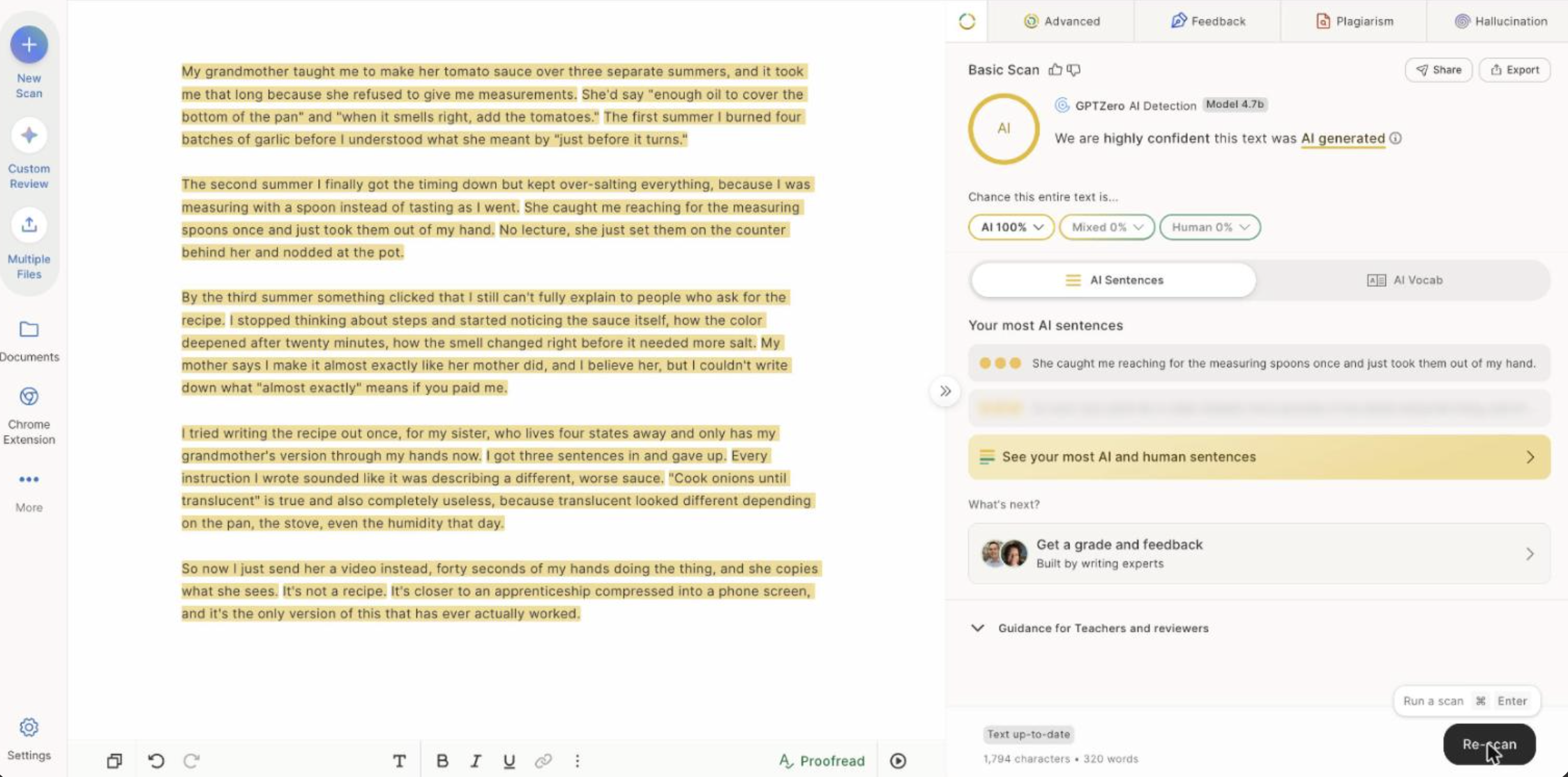
GPTZero: 100% AI
The most widely used detector in classrooms opened the scoring with its worst possible verdict: "We are highly confident this text was AI generated." Not hedged, not borderline. 100% AI, 0% human, on a story about my grandmother taking measuring spoons out of my hand.
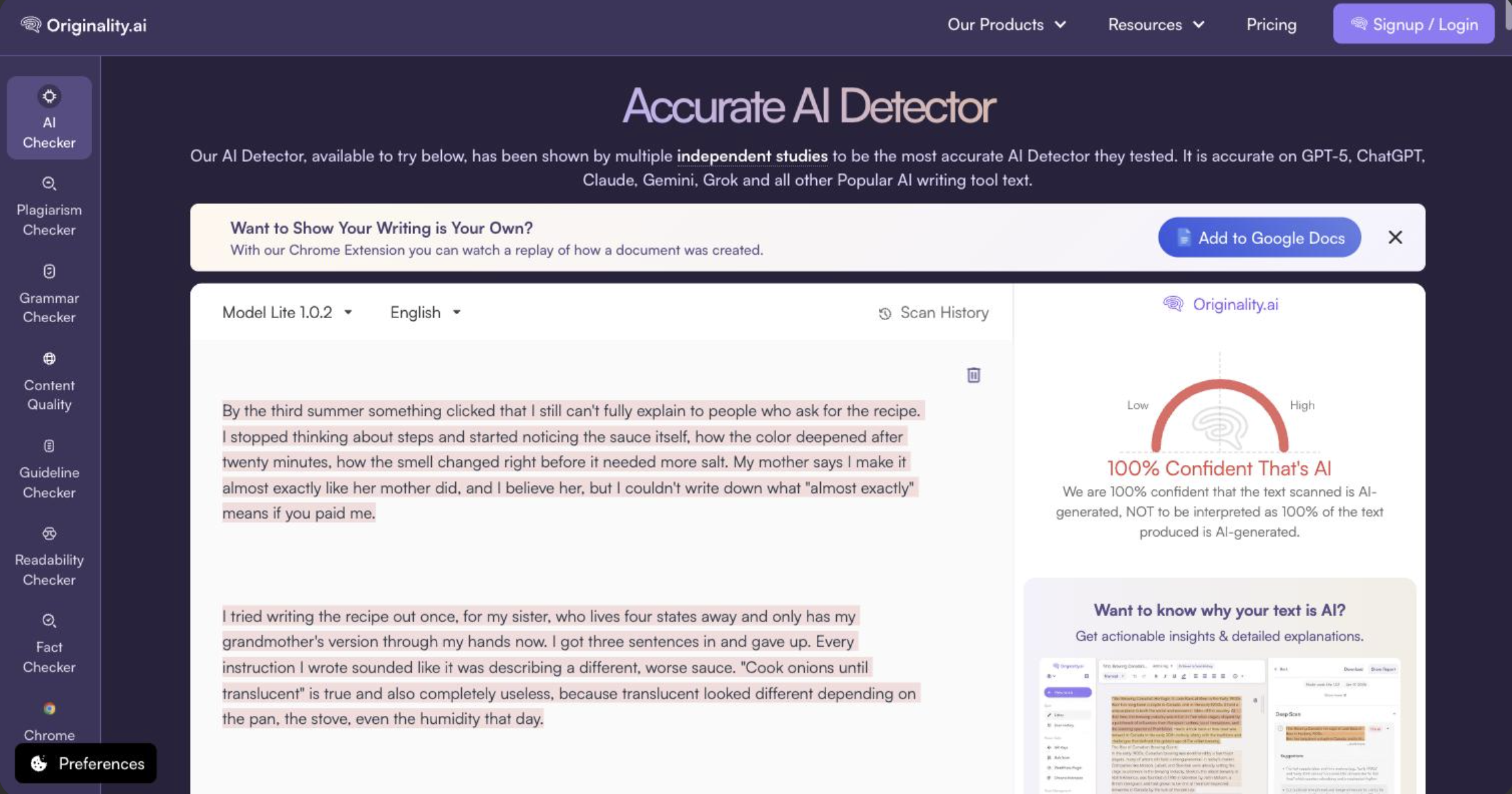
Originality.ai: "100% Confident That's AI"
Originality.ai markets itself as the detector for publishers and SEO teams, and it doubled down with the most confident wrong answer of the day. Its own disclaimer says the number means confidence, not proportion, which somehow makes it worse: the model is maximally sure about something that never happened.
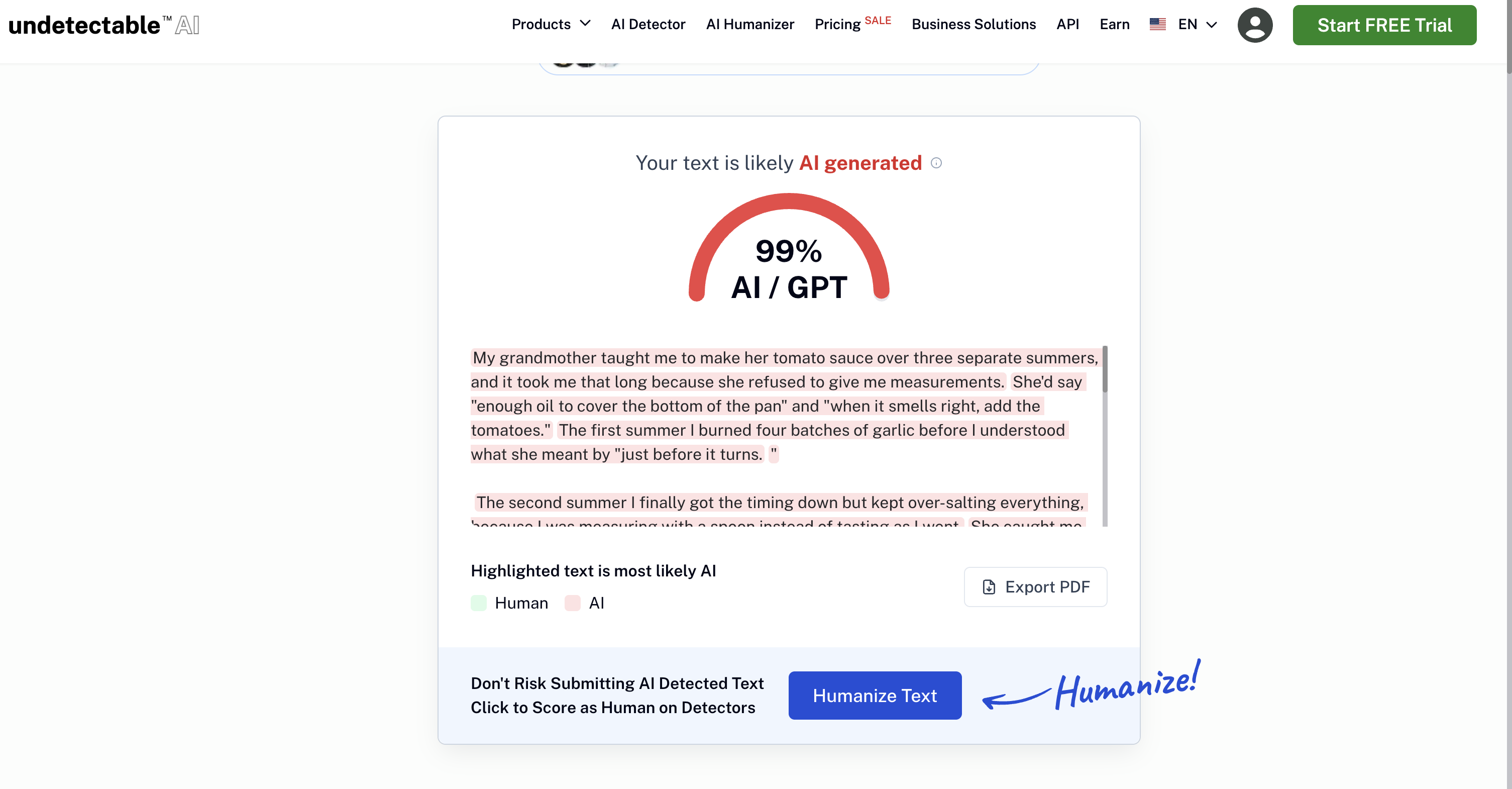
Undetectable AI: 99% AI/GPT
Undetectable AI highlighted nearly every sentence of the essay in red, its color for "most likely AI." The one percent it left me felt almost polite. Directly under the verdict sits a "Humanize Text" button, which tells you something about the incentive structure: the scarier the score, the more likely you are to pay for the fix.
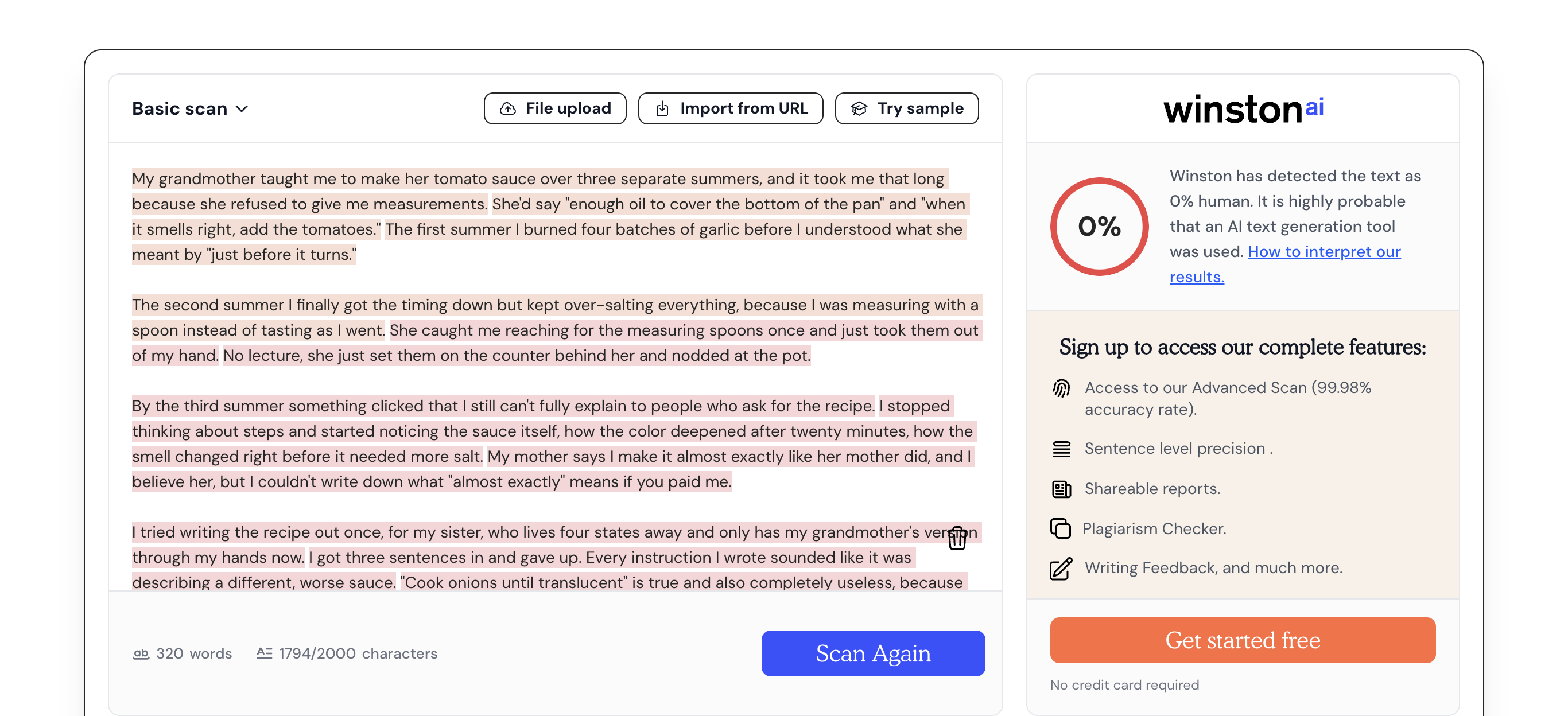
Winston AI: 0% human
Winston advertises a 99.98% accuracy rate on the same page where it scored a fully human essay as 0% human, "highly probable that an AI text generation tool was used." Zero percent doesn't leave room for a single sentence of mine to have been written by me. I wrote all of them.
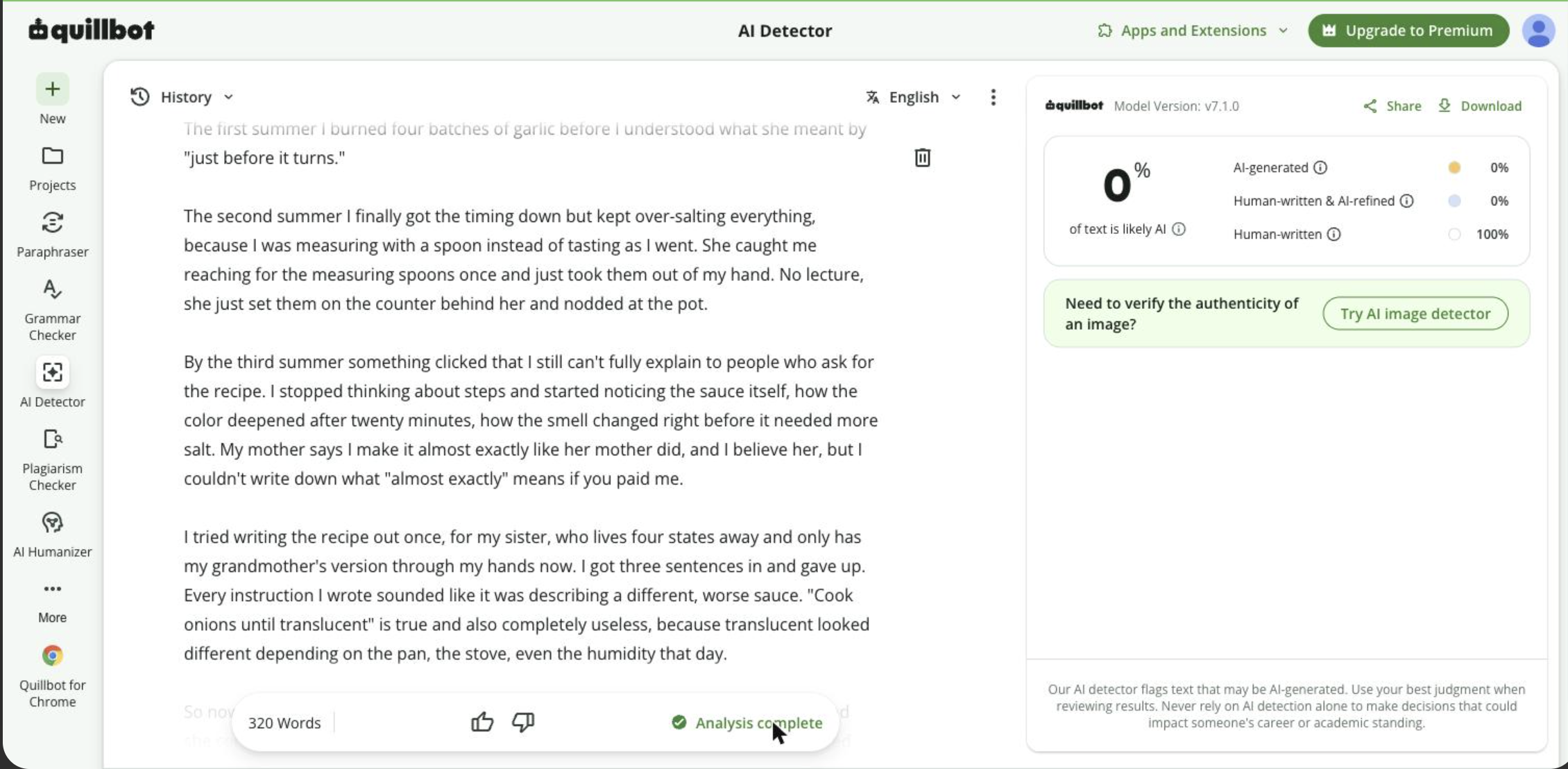
QuillBot: 0% AI, the only correct verdict
One tool read the same 320 words and called them what they are: 100% human-written, 0% AI, 0% AI-refined. Worth knowing if you compare detectors yourself: Scribbr's AI detector, another name that shows up in every "best detector" list, is this same QuillBot engine under different branding, so it isn't an independent second opinion.
Why the same paragraph gets five different verdicts
These tools aren't reading for meaning. They're scoring perplexity and burstiness, essentially how predictable each word is given the words around it, and how much sentence length and rhythm vary across a passage. My essay leans into short, plain sentences in places ("No lecture, she just set them on the counter behind her and nodded at the pot"), which is exactly the low-variance pattern these models are trained to associate with machine text, even though plain, understated prose is also just how a lot of people actually write about their families.
Where the five tools genuinely differ is in where they draw the line. Based on this result, GPTZero, Originality.ai, Undetectable AI, and Winston AI are all tuned toward catching as much AI text as possible, which as a side effect catches more human text too. QuillBot's engine came out tuned more conservatively on this specific text. Same underlying signal, different thresholds, opposite verdicts on identical input.
What this would mean in a real classroom
Imagine this exact essay turned in as a class assignment. If the instructor happened to reach for GPTZero, Originality.ai, Undetectable AI, or Winston AI, that student walks into an academic integrity meeting over writing they produced entirely on their own. If the same instructor happened to reach for QuillBot instead, nothing happens at all. The student did the same work either way. The only variable was which browser tab their professor had open.
And this wasn't a trick paragraph built to fool detectors. It was an ordinary personal story, the kind real people write constantly. Specific, first-person, unpolished the way memory is unpolished. If that gets called machine-made by four well-funded commercial tools, the lesson isn't that detectors are worthless. The lesson is narrower and more useful. No single detector score is proof of anything, in either direction. A low score doesn't clear you. A high one doesn't convict you.
What to actually do with this
A few things that follow directly from these results:
- Never trust one detector's number in isolation. If a single tool is the entire basis for an accusation, ask what a second one says. This test shows two "trusted" tools landing 100 points apart on identical text.
- Check your own writing before you submit it. A free AI detector won't tell you the truth with certainty, nothing does, but it tells you whether your draft currently sits in flagged territory while you still have time to do something about it.
- Understand what the number in front of you actually measures before you argue about it. Turnitin's score, for instance, measures something narrower than most people assume, and knowing that changes how you respond to it.
- Know if you're in a group these tools misjudge more often. Non-native English writers get flagged at dramatically higher rates than native speakers, and the published research on why is worth reading before you ever need it.
Five verdicts, one true answer
The essay was 100% human the entire time. That fact never changed. What changed was which detector happened to be looking at it, and that's the whole finding in one sentence. If your writing gets flagged, that's information about the tool that flagged it as much as it is about your writing, and now you have five screenshots to point to instead of a hunch.
I'm keeping the original 320 words in case anyone wants to rerun this comparison against newer versions of these tools. Detector models get retrained often, so a result from today isn't guaranteed to hold in six months, which is one more reason a single score should never be treated as a final answer.